



You Don’t Need More Motivation — You Need a System That Works
- 3 months Ago
- 0 Comment
- 4 Min Read

We often find ourselves trapped in a cycle of waiting for a “spark” to begin. We tell ourselves that once we feel inspired, we’ll finally start that business, finish that book, or stay consistent with a new routine. We treat motivation as the engine of our progress, but in reality, motivation is a feeling—and feelings are notoriously unreliable.
If you only show up when you feel like it, you will never build anything that lasts. To achieve real results, you have to stop relying on your mood and start relying on a system.
The Reliability Trap
Most of us have been taught a logical fallacy: that “feeling ready” is a prerequisite for taking action. We wait for a Monday or a fresh start, only to find that by Wednesday, the initial excitement has faded. This isn’t a personal failure of discipline; it’s a failure of design.
Motivation is designed for short-term bursts. It works well when a task is new, the outcome is immediate, or the effort required is low. However, most meaningful work is repetitive and the results take time to appear. When the “newness” wears off, motivation naturally drops. If your progress depends entirely on how you feel, your output will be as unstable as your emotions.

“If you only show up when you feel inspired, you will never build anything that lasts.”
Why Systems Outperform Willpower
A system is a repeatable process that produces a specific result without requiring a constant internal debate. While motivation asks, “Do I feel like doing this right now?” a system simply states, “It is 9:00 AM; this is the task for this hour.”
When you move from a feelings-based approach to a framework-based one, you remove the “mental friction” that kills consistency. You stop wasting energy arguing with yourself about whether or not to start because the decision has already been made for you.
How to Build a System That Actually Runs
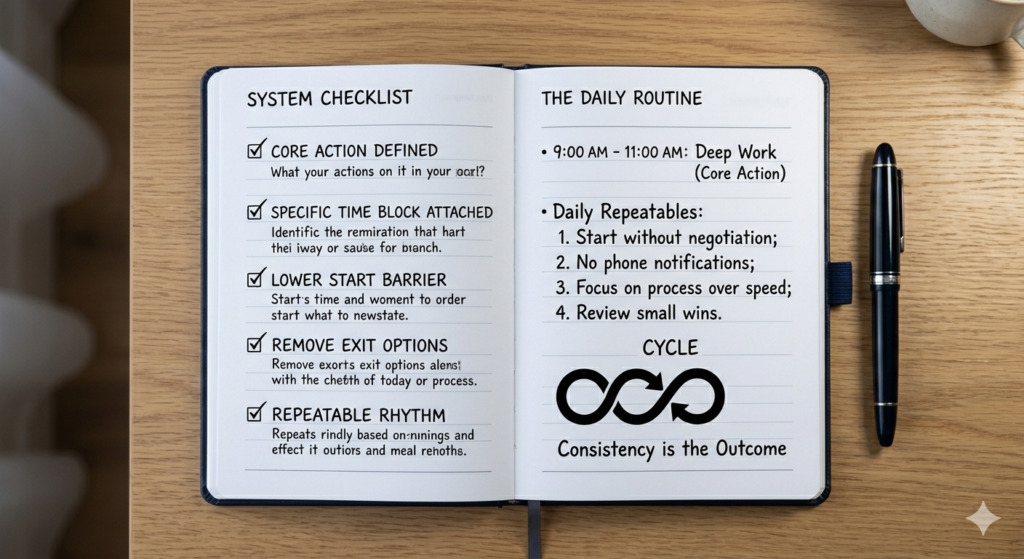
A functional system doesn’t need to be complex to be effective. In fact, the most sustainable systems are often the simplest. To build a process that carries you through the days when your energy is low, consider these five steps:
1. Define the Core Action. Identify the one activity that truly moves the needle. (e.g., If you are a writer, the core action is writing words).
2. Tie the Action to a Specific Time. If a task isn’t on your calendar with a start and end time, it remains optional. Treat these slots as non-negotiable appointments.
3. Lower the Barrier to Entry. Friction is the greatest enemy. Design your starting point to be so easy that it’s almost impossible to say no.
4. Remove the Exit Options. A good system protects you while you do it. Identify your common distractions—whether it’s your phone or multitasking—and create an environment that eliminates them during your work block.
5. Make It Repeatable. Consistency comes from repetition, not intensity. Ask yourself if the pace you’ve set is something you can realistically maintain for the next ninety days.
Pause here. Look at your current workflow. Are you relying on intensity, or are you relying on repetition?
“You don’t rise to the level of your goals; you fall to the level of your systems.”
The Shift to Professionalism
There is a deeper truth we often avoid: systems remove our excuses. When there is a clear structure in place, it becomes obvious whether or not we did the work. It’s often more comfortable to blame a “lack of motivation” than to admit we didn’t follow a simple plan.
The next time you feel stuck, don’t go looking for a motivational video or a new quote. Instead, look at your environment and your schedule. Stop asking how you feel today and start asking what your system requires of me today. Success isn’t about being fueled by constant inspiration; it’s about having a process that works even when the inspiration is nowhere to be found.